

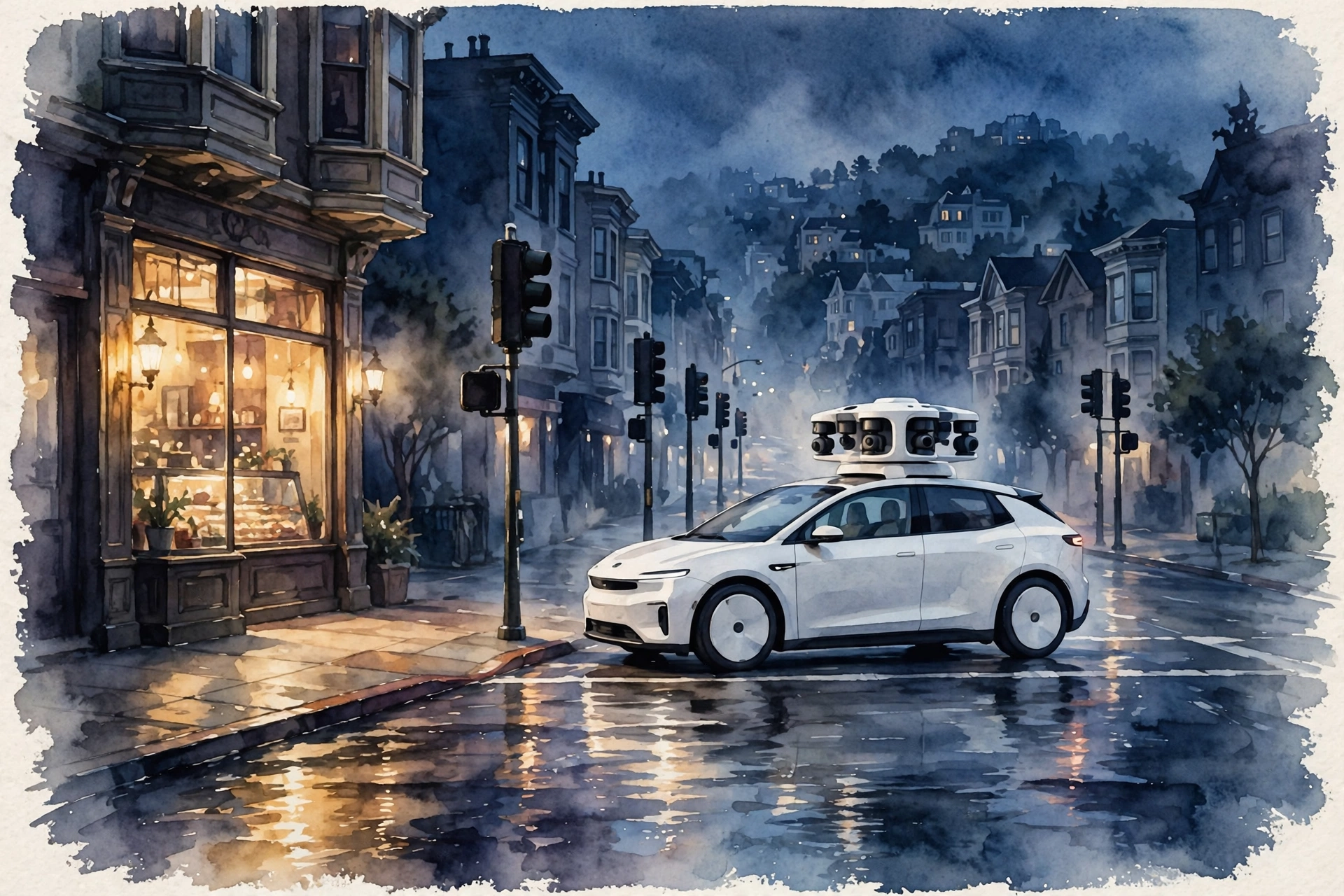
A Waymo Talks

On the night of December 20, 2025, a fire in a PG&E substation cut power to nearly a third of San Francisco. The traffic lights went dark. Waymo cars across the city stopped at the dead signals and asked a human whether to go.
No red, no green, nothing. The car’s cameras see a light that is off.
The car’s software has a rule for that. If you cannot read the signal, stop, and ask the company.
So the car stops, and it sends a message to a Waymo office. The message carries the pictures from the car’s own cameras, so the office sees the same dark intersection the car sees.
In that office, a person sits at a desk with a screen. About 70 human agents are on duty at any time, in Arizona, in Michigan, and in two cities in the Philippines. The question appears on the screen, with the pictures.
The person looks at the intersection and answers the one question: may this car go through? The person taps an answer, the way you tap yes on a phone. The person has no steering wheel, no pedals, no brake. There is no way for that person to move the car.
The answer travels back to the car. The car then drives itself through the intersection. Its own software steers. Its own software works the pedals. The person in the office is already waiting for the next car’s question.
That is the whole interaction. The car asks. A person answers. The car does the driving.
When the car meets something it cannot read, it can ask for help. Waymo calls the team Fleet Response. The team is human. The company described it in its own blog — like phoning a friend. The car sends its question over an encrypted phone connection. The person who answers sees the feeds from the car’s outside cameras and can answer the question, mark a lane closed, or suggest a path. The person cannot drive the car. Waymo told the United States Senate in a letter on February 17, 2026, “We do not utilize remote drivers.”
The agents give advice only when the car asks. The car can reject the advice. The advice is advice, not a command. The car’s own software holds the last word. If it judges the answer unsafe, it does not take it. If the connection drops, the car drives on and finds a place to pull over.
A Waymo mostly talks to itself. Before the company sends its cars into a new city, its mapping team drives every street and builds a detailed three-dimensional map, down to the curbs and the crosswalks. The car carries that map on board. As it drives, it matches what its lidar, its cameras and its radar see against the map, and that match tells the car where it is. Lidar measures distance with light. It fires out quick pulses of laser light in every direction and times how long each pulse takes to bounce back. From those times, the car builds a picture of what stands around it, and how far away each thing is. Radar does the same job with radio waves. Lidar’s picture comes out finer. Satellite positioning is only a backup. The car does not need it, and it does not need a live connection to the company to drive.
A typical exchange lasts seconds.
On the blackout night, the questions came all at once. Waymo said its cars crossed more than 7,000 dark signals that day. So many cars asked for a confirmation check at the same time that the answers backed up. The company’s own figures, given to California regulators, counted 1,593 times a car sat stopped for two minutes or more. Waymo sent roadside crews into the streets, and people moved up to 64 of the cars by hand, one at a time, out of the intersections they blocked. San Francisco’s dispatchers placed 31 calls to Waymo’s first-responder hotline that afternoon and spent 2 hours and 36 minutes on them, most of it on hold.
The advice can also be wrong. On January 12, 2026, in Austin, Texas, an empty Waymo stopped the right way, facing a school bus that was loading students, its red lights flashing and its stop sign swung out. The law says every car must stop while it is out. The car asked its question. Is this a school bus with active signals? A remote assistance agent in Novi, Michigan, answered, “No.” The car drove past the bus. The National Transportation Safety Board reported the case in March. Nobody was hurt, and the investigation is still open.
A ride starts in the app. You put in where you stand and where you are going, and ask for the car. The company picks a car near you and sends it the trip. No person assigns it. The car drives itself to you, empty.
The passenger talks to a different team. Rider Support, led by humans, answers around the clock, by voice, chat or text, from the Support button on the screen inside the car or the Help tab in the app. That team talks to the rider. It does not advise the car. If a crash is detected, support is notified on its own and calls into the car through its speakers.
The cars do not talk to each other, and they do not take signals from the traffic lights. The cameras read the lights. When one car finds that a road changed, the change goes to the company’s operations center, and the center shares it with the fleet.
One thing is recorded. Waymo’s privacy policy says the company records video inside the car during trips. It records audio only during a call with Rider Support, or when a rider turns the microphones on. Waymo says it does not use facial recognition.
What the company will not say is how often its cars ask for help. Senator Edward Markey, of Massachusetts, asked seven driverless-car companies that question this year. Every one of them refused. Waymo called the number confidential business information.
In The News
Huang Agrees to Answer
Jensen Huang agreed to answer lawmakers’ questions in private about his relationship with Alice Huang. John Moolenaar, the Michigan Republican who chairs the House committee on China, said so on Sunday.
Huang will appear before members of three House committees: Foreign Affairs, Intelligence, and the committee on China. No date has been set.
The committees asked Huang to sit for a closed-door interview on December 1, and said they would subpoena him if he did not accept by Friday evening. Moolenaar said Huang’s voluntary cooperation removed the need for a subpoena.
No word has come on whether Tim Teter, Nvidia’s general counsel, has answered the committees’ request for a December 2 interview. The Senate Banking Committee asked Huang to testify in public on December 3.
The questions will be about Alice Huang. One question is whether she is a spy. An Al Jazeera television segment already answered that one, and stated it as fact.
Al Jazeera Calls It a Spy Scandal
On Friday, November 13, Al Jazeera ran a television segment on Nvidia. The network’s journalist Osama Bin Javaid posted the segment on LinkedIn the same day, with a written transcript.
The segment states as fact that the Federal Bureau of Investigation is investigating a spy scandal. It calls Alice Huang the woman American intelligence reportedly suspects of links to Chinese intelligence.
Alice Huang was an executive at Megaspeed, a Singapore company under investigation over purchases of Nvidia chips.
One day before the segment, Singapore published the record of its own investigation of Alice Huang. The Home Affairs Ministry said its investigation suspected false declarations about server purchases. It was not an espionage investigation. Alice Huang was not charged. She was given a stern warning and barred from returning to Singapore.
On Thursday, November 12, Attorney General Todd Blanche said the Justice Department has not reached a conclusion on whether Alice Huang is a spy.
The segment names no source for the claim of an FBI investigation.
The record was set straight in Singapore. In Santa Clara, the question of who runs Nvidia is still open.
Huang Weighs a Return
On Sunday, The Financial Times reported that Huang discussed the possibility of returning with confidants. The newspaper did not name the confidants.
One unidentified ally told the newspaper he is putting together a group of Silicon Valley executives to lobby Nvidia’s board for Huang’s reinstatement, and to seek support from the White House. Spokespeople for Nvidia and for Huang declined to comment to the Financial Times.
Treasury Secretary Scott Bessent said on Sunday that the board should hire an outsider as the next chief executive. He said the board needs a dramatic shakeup, and he wants answers in the next ten days from the board and from the outside lawyers it hired, on whether Nvidia pushed sales to China that broke export rules to raise its revenue and earnings.
Nvidia did not answer Bessent in public. The board said it is still choosing a search firm and has not formally approached any candidate.
Wars rage on and AI is playing a role.
On Monday, more than 120 states meet in Geneva to decide whether the world will open negotiations on rules for weapons controlled by artificial intelligence, weapons that choose and strike their own targets. The meeting is the Seventh Review Conference of the Convention on Certain Conventional Weapons. It runs through Friday.
The conference will take up the final report of a group of government experts, which sets out the elements of a possible treaty. The campaign group Stop Killer Robots counts 130 countries behind a legally binding treaty. The United States and Russia remain opposed.
The weapons are already in use. Both Russia and Ukraine have used small numbers of fully autonomous exploding drones.